Good evening.
Excellencies, Distinguished Guests, Ladies and Gentlemen,
It gives me great pleasure to welcome you this evening to the Residence of the High Commissioner of Sri Lanka for what I hope will be an enjoyable evening of stories, memories and conversations.
For more than six decades, this Residence has been Sri Lanka's home in India.
Since its foundation stone was laid in 1960 by Prime Minister Sirimavo Bandaranaike – the world's first woman Prime Minister – it has welcomed presidents, prime ministers, ministers, diplomats, scholars, artists, writers, business leaders and countless friends of Sri Lanka.
But beyond its official role, this has always been a house of conversations.
Conversations that have strengthened friendships between Sri Lanka and India, and between Sri Lanka and friends from around the world. Conversations that have exchanged ideas, built understanding and created lasting friendships.
This evening, we add another conversation to that tradition.
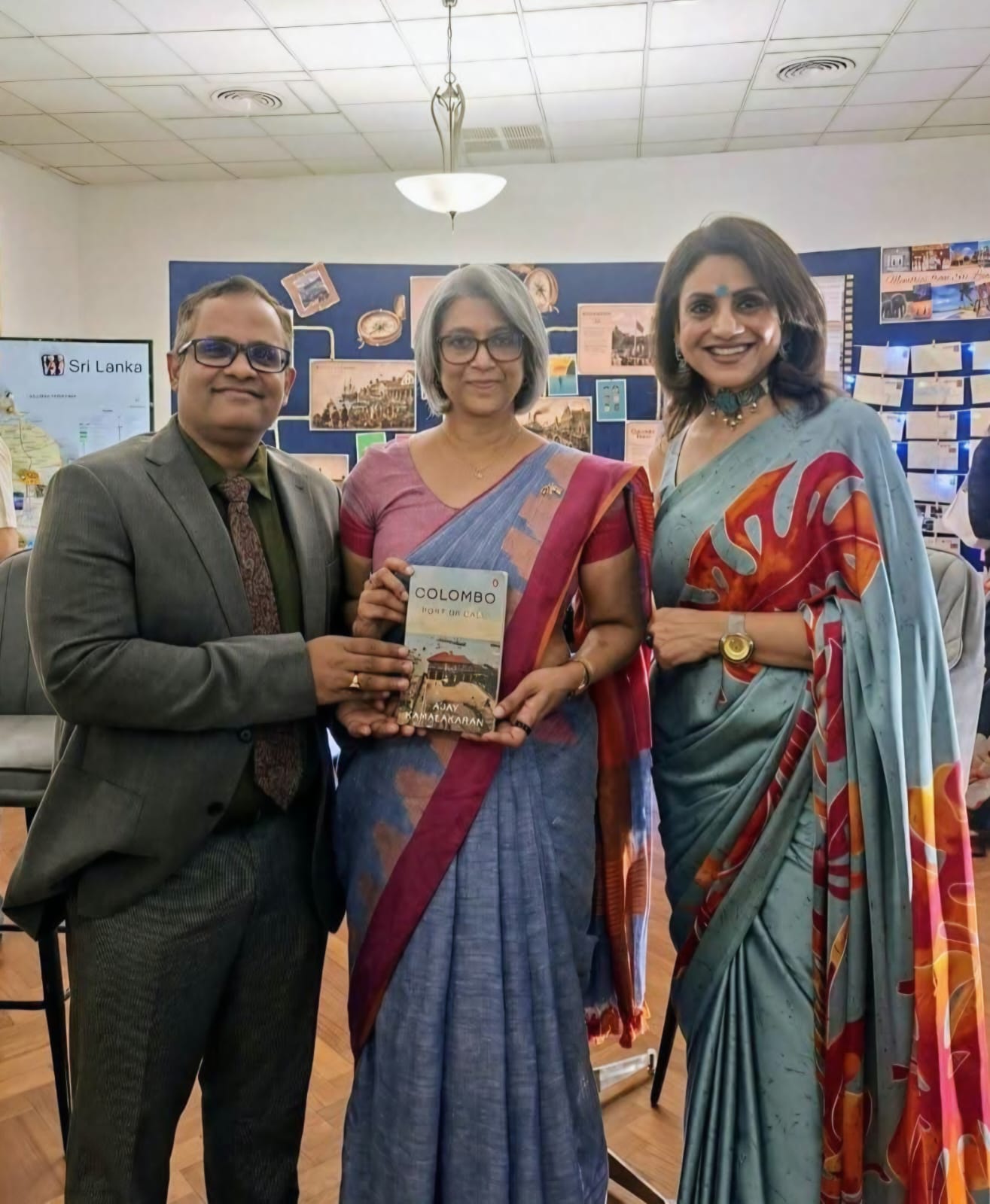
This is not a formal launch of “Colombo: Port of Call”. The book has already begun its own successful journey and found readers in many places. This evening, we have gathered for something I hope is even more enjoyable – an opportunity to sit with the author, hear the stories behind the stories, and allow the book to spark new conversations.
If I could, I would have loved to take all of you to Colombo for this discussion. Since that is not quite practical, perhaps this evening we can do the next best thing.
For the next hour or so, let us bring Colombo to the Residence.
Every city has two histories. One is written in archives, government records and history books.
The other is written by those who arrive there: travellers, pilgrims, merchants, diplomats, writers, exiles, and artists. People who see a city with fresh eyes and leave behind impressions that sometimes tell us as much about the place as any official record ever could. That, to me, is what makes this book so special.
Ajay Kamalakaran has gathered together voices spanning centuries and continents.
Mary Thorn Carpenter arriving by sea and breathing, in her words, "the cinnamon-scented air of Colombo."
Prince Esper Ukhtomsky accompanying the future Tsar Nicholas II and seeing an island where civilizations, faiths and traditions intertwined.
Mahatma Gandhi admiring not only the natural beauty of Ceylon but also the spiritual inheritance preserved there.
Anton Chekhov finding, after one of the most exhausting journeys of his life, what he simply called "paradise."
Urabi Pasha, arriving not as a traveller but in exile, discovering that Colombo could also be a place of refuge.
Each encountered a different Colombo. Together, they remind us that no city is ever experienced in quite the same way twice.
What I especially enjoy about this book is that it is not simply about famous visitors. It is about encounters. About how places shape people. And how people, in turn, shape the memory of places.
Ports have always done that. Ships entering Colombo carried more than goods. They also carried ideas, languages, religions, music, architecture, science, literature, and countless human stories.
Colombo became far more than a harbour. It became a meeting place of civilizations. A place where journeys paused long enough for friendships to begin.
When we sent out invitations for this evening, we asked each of you to send us just one sentence – a memory of Colombo or Sri Lanka.
I wondered whether we would receive any responses.
To my surprise, what we received could be described as stories.
One guest remembered discovering the second-hand bookshops in Maradana and spending hours searching for just one book, before inevitably leaving with many more.
Another wrote of the smile of an elderly woman near Kandy who offered an araliya flower from her basket.
Several remembered Galle Face Green.
Another remembered the Galle Literary Festival.
Someone described Sri Lanka as a second home.
Someone else, who has yet to visit, wrote that his image of Colombo had already been shaped by the warmth of its people and the centuries of connection between our two countries.
Reading these messages, I realised something rather lovely. The story of Colombo did not end when this book was published. It is still being written by everyone who visits. By everyone who leaves carrying a memory home. And perhaps by everyone gathered in this room this evening.
As diplomats, we often speak of bridges between nations. Sometimes we think of those bridges in terms of trade, physical or digital connectivity, or political engagement. Important though all of those are, there is another bridge that matters just as much. The bridge built by stories.
Stories create familiarity. They replace assumptions with understanding. They remind us that behind every country are people whose lives, hopes and memories are often remarkably similar to our own. That is what books like this quietly achieve.
Ajay, on behalf of the High Commission and all of us gathered here this evening, thank you for giving voice to so many Colombos, and for reminding us that every visitor leaves with a different story of the city.
My sincere thanks also to Shibani for graciously agreeing to lead this evening's discussion.
This Residence has welcomed many conversations over the years. This evening, it has the privilege of welcoming another conversation – one inspired by a city that has welcomed the world for centuries.
I hope you enjoy the evening.
Thank you for being here.